Book Reviews

Ribbons of Scarlet Review

Ribbons of Scarlet by Kate Quinn, Stephanie Dray, Laura Kamoie, Sophie Perinot, Heather Webb, and E Knight

Rating: ⭐️⭐️⭐️⭐️⭐️/5

Ribbons of Scarlet is one of the greatest novels about the French Revolution that I have ever read. I love that six female authors came together to write a novel about the women of the French Revolution. And I absolutely love that the historical women in the book are from all walks of life—from the nobility to the poor market women in Paris. 

Ribbons of Scarlet is divided into sections about each woman—Sophie de Grouchy (the philosopher), Louise Audu (the revolutionary), Princess Elisabeth (the pious princess), Manon Roland (the politician), Pauline Leon and Charlotte Corday (the assassins), and Emilie de Sainte-Amaranthe (the beauty).

The central theme of each section always centers around each woman’s view of what being a woman means during the chaotic years of the French Revolution. Each other displayed the struggles women faced when they sought independence in a society controlled by patriarchal standards. Even during a significant revolution, women face oppression. Each woman had to confront their fears about the barriers society forced upon them, forcing them into submission and servitude to men’s whims and traditions.

I love that there are so many different points of view on the roles of women in the 18th century. One woman may find joy in marriage and motherhood, while another sees that life as the end of her freedom and life. One woman will always share her point of view, while another regretfully bends to the words of the men in her life. It was wonderful to compare and contrast the lives and beliefs of the women featured in Ribbons of Scarlet.

One of my favorite parts of the novel was the Assassin section. It was so interesting seeing the similarities and differences between Charlotte Corday and Pauline Leon, who have polar opposite views on the radicals in the revolution. Yet, they both use violence to get the points across. I also loved the conversation between Sophie de Grouchy and Manon Roland—two women who are very vocal in their opinions and, as a result, are degraded and called whores. The similarities in their marriages and differences in their progress were fascinating to read.

The continuity between each woman’s story was perfection. I love that it showed the continuation of the revolution from different viewpoints but was still clearly thought out and easily understood as a timeline of events. It was also amazing to see how one character from one section could affect a character from another section’s story and actions.

Finally, I loved how realistic and emotional each author’s writing felt. Each author was unafraid to get into the gritty details of the horrific Reign of Terror and all the emotions that went with it. As a woman reading Ribbons of Scarlet, I experienced an array of emotions, from anger to happiness to sadness to pride. The novel was indeed an emotional and thought-provoking experience.

Ribbons of Scarlet is a must-read for historical fiction fans, women’s fiction fans, and people who love to read about the French Revolution.

Favorite Quotes from Ribbons of Scarlet:

  • Nothing spares women…Whether we ask for the vote or only for bread, whether we march on the streets or keep to our salons, there are those who will find us at fault–and make us suffer for the crime of asking for more.
  • We trade wry smiles: two women who have been called whores, simply because that is the word for any woman with an opinion and a voice to express it.” 
  • Because as much as [Jacobins] killed my countrymen, they seemed to take a sick, perverted glee in killing my countrywomen. They killed us for being too political, too intelligent, too opinionated, too daring, too pretty.
  • The crowd around my guillotine hushed and cried, but around others the people cheered and celebrated. Beautiful, terrible humanity. Capable of the most inspiring and creative genius and the greatest and most unimaginable abominations.
Book Reviews

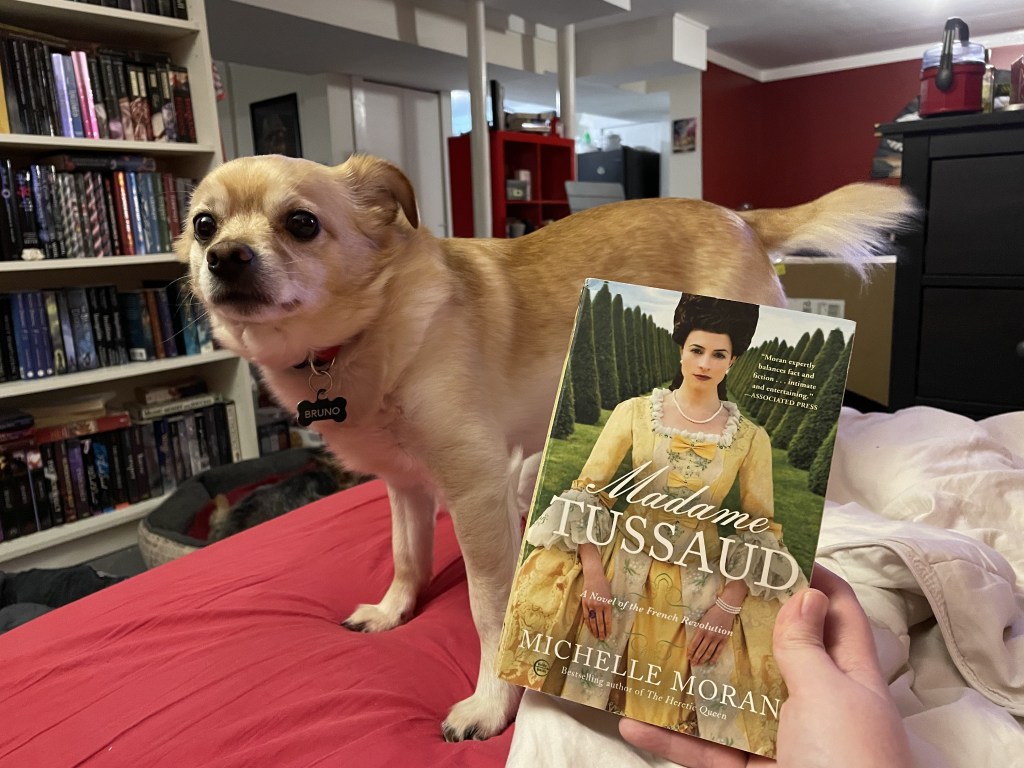
Madame Tussaud Review

Madame Tussaud by Michelle Moran

Rating: ⭐️⭐️⭐️⭐️⭐️/5

Madame Tussaud by Michelle Moran explores Marie Grosholtz’s life during the French Revolution. The story begins a year before the revolution and ends in 1802 when Marie finally leaves France.

My five-star rating is very much deserved! Madame Tussaud is a historical novel with some fictional twists, but it felt like I was experiencing what was happening in France while reading Moran’s words. Every piece of dialogue felt believable. Moran definitely put a lot of effort into producing a historically accurate take on Marie’s horrifying experiences during the Reign of Terror.

Unlike Edward Carey’s Little, Moran spent time creating an emotional bond by expressing the emotions and feelings of the characters. Moran was fearless in exploring the everchanging emotions of the French people in Paris during the revolution.

The relationship between Marie and her brothers was brilliant, especially her oldest brother Edmund. Moran delved into the complex relationship siblings have. The stormy and distant relationship between Edmund and Marie greatly contrasts Wolfgang (her youngest brother) and Marie’s loving relationship. I loved Edmund and Marie’s story arc near the book’s end. It showed how the terrible events of the revolution changed everyone in France.

I loved the sprinkle of romance present throughout the book. Henri was so caring, patient, and kind to my dear Marie. Their love story was a pleasant break from the many (and I mean MANY) awful things happening in Paris. I would have loved to see what their reunion was like at the end of the book.

Moran did a great job displaying how Marie toed the line between the royalists and the revolutionaries. The relationship between Madame Élisabeth and Marie (King Louis XVI’s sister) was refreshing. In contrast, Marie’s sometimes cautious interactions with figures like Robespierre, Danton, and Marat were riveting. Moran examined as many views on the revolution as she could in the novel. She was not afraid to discuss the genuinely heart-wrenching moments of Marie losing loved ones to the Reign of Terror. The moment Marie is forced to make her first death mask was weirdly captivating. I felt like I was sitting right next to Marie while the mob pushed the bloody, decapitated head into her hands.

I loved Moran’s take on historical figures like Marie Antoinette, Thomas Jefferson, Marquis de Lafayette, and Maximilien Robespierre. She brought these people to life in a very genuine way.

Overall, I loved Madame Tussaud. I recommend this masterpiece to anyone interested in the French Revolution and historical fiction. This novel has motivated me to look into Moran’s other books. I loved her writing style and look forward to reading more of her work.

Book Reviews

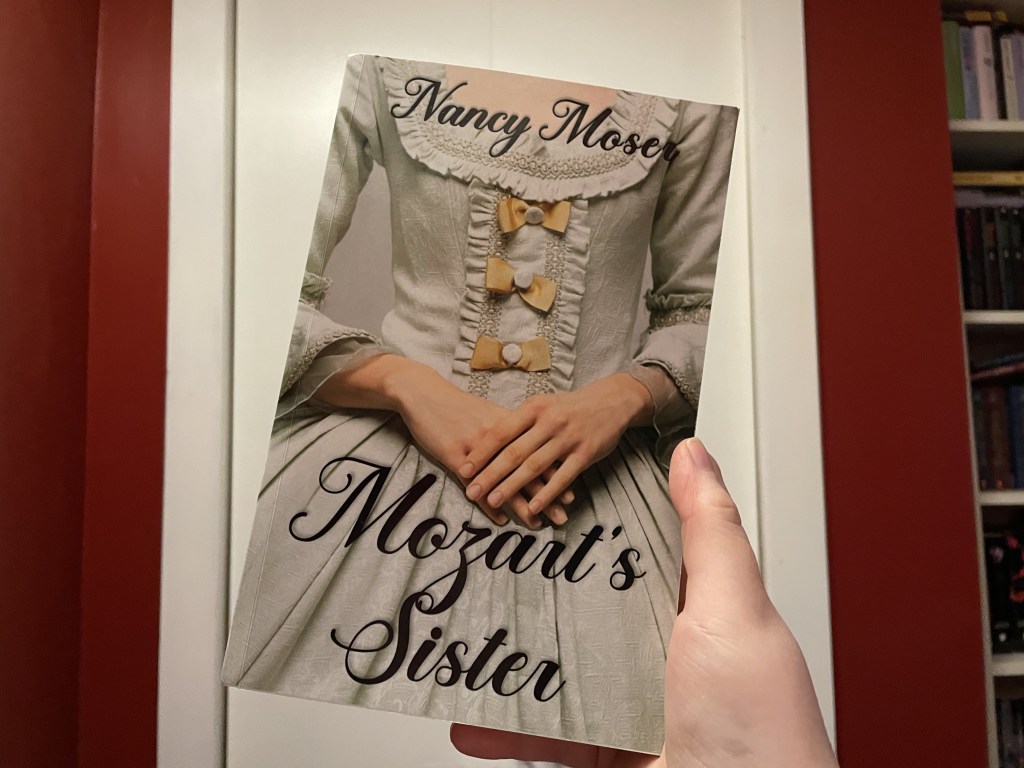
Mozart’s Sister (Moser) Review

Mozart’s Sister by Nancy Moser

Rating: ⭐️⭐️⭐️⭐️/5

In Nancy Moser’s biographical novel Mozart’s Sister, the adventures, losses, family life, and love life of Maria Anna Mozart’s life are laid out for all to see. This is the second book I’ve read about dear Nannerl (the first being Mozart’s Sister by Rita Charbonnier). Funny that both books share the same title. That perfectly reflects the shadow Wolfgang Mozart cast over his very talented sister.

The interactions between the Mozart family felt much more personal in Moser’s book than in Charbonnier’s. Papa and Mama Mozart were very present in Moser’s novel. I loved that. Papa Mozart has always been labeled as the authoritative, strict father who pushed his children too far. But, in Moser’s novel, his humanity is ever-present. It was a nice change to Charbonnier’s novel. I also loved that Moser gave Mama Mozart a chance to shine. She is always a background character when people speak of the Mozart family. Moser showed a glimpse of the inner workings of Mama Mozart in a heartbreaking way. I felt so bad for poor Mama Mozart. The interactions between Nannerl and Wolfgang felt very realistic to how an older sister and younger brother would act. I like that Moser reflected Nannerl’s struggle with being jealous of Wolfgang. It humanized her even more to me. It’s normal to be envious of a sibling. It’s normal to want attention from a parent.

I loved that Moser wrote about the struggles each member of the Mozart family faced. Each person faced their own obstacles, whether being stuck in their brother’s shadow or escaping their controlling father. Every Mozart family member had a moment to express themselves. It did not feel biased. Every conversation between the Mozart family felt like it could have actually happened. That shows how much care Moser gave to shaping each character.

Nannerl’s transformation from a younger girl to a grown woman was written spectacularly. Moser displayed Nannerl’s battle with growing older and losing the title of Wunderkind in such an emotional way that I felt like I was experiencing this evolution with Nannerl. Something interesting about Moser’s novel was the use of religion throughout the book. Unlike Charbonnier’s novel, Nannerl is very in tune with her religious beliefs and God in this book. I didn’t mind that because Moser used Nannerl’s spirituality in a subtle way to drive her character arc. Nannerl used her religion to find peace. This made perfect sense for the novel because religion held much power over Europe then.

Regarding Nannerl’s love life, I wish there were more interactions between Captain Franz d’Ippold and Nannerl! I loved their relationship. It felt organic. It felt like a real love story was brewing. The longing was ever present, which took hold of my heartstrings. However, Moser could have expressed Nannerl’s agony over not being allowed to marry Franz.

Overall, this was an excellent historical fiction novel with great historical accuracy. Moser definitely did her due diligence while researching the life of Nannerl Mozart. When it comes to Charbonnier’s Mozart’s Sister or Moser’s Mozart’s Sister

I choose Moser’s!

Book Reviews

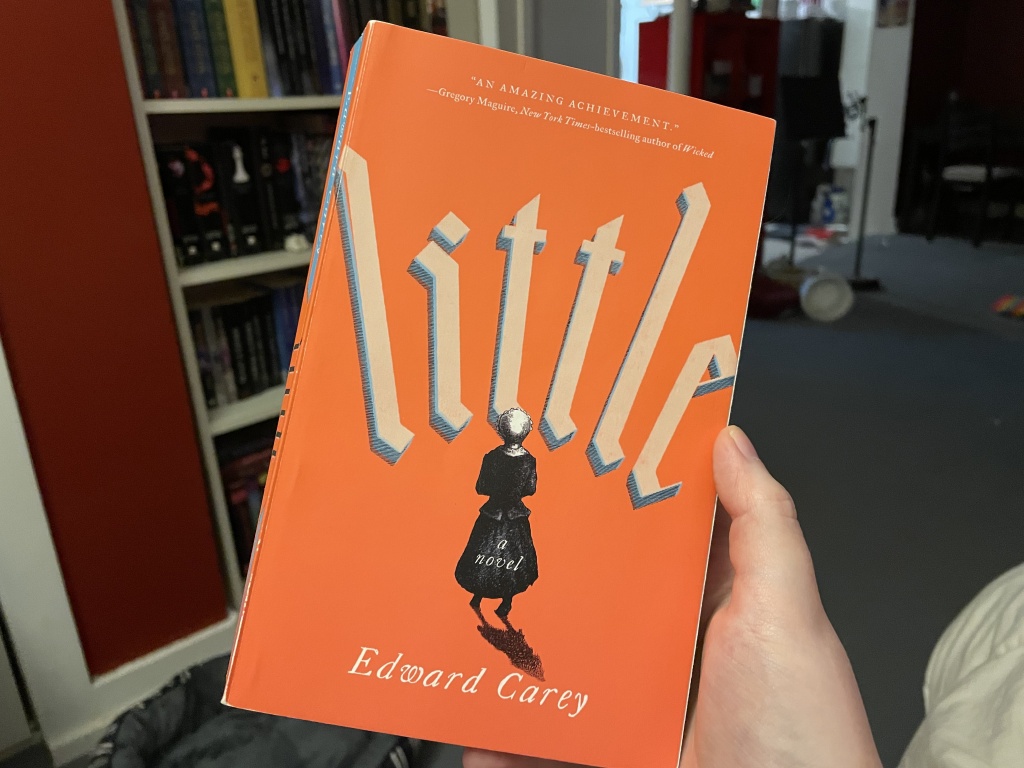
Little Review

Little by Edward Carey

Rating: ⭐️⭐️⭐️/5

Edward Carey’s Little tells the story of Marie Tussaud, the woman known for her famous wax sculptures. The novel encompasses her life from Marie’s birth to her death. From the early years of her life learning about wax to her time in Versailles to her years making death masks during the French Revolution. 

Little is written from Marie’s point of view in the first person, and because of that, I experienced a most interesting, yet odd, mind. I have never read a book where the anatomy of a human being is used so many times to describe emotions, places, and events. Marie was particularly obsessed with analyzing and detailing people’s facial features and mannerisms. This facet of Carey’s Marie made sense for her character as her love for wax figures grew. 

Once the character Dr. Curtius, her mentor, entered the scene, there was never a chapter where a human body part wasn’t used as a symbol. At times, it felt like too much, but I understood this was just a part of who Marie was, whether I liked it or not. The mix of art and anatomy was handled in a way I had never read before, and that in itself was intriguing. However, a lot of the time (especially once Marie and Dr. Curtius move to Paris), the emotional aspect of the novel was lost to me. 

I couldn’t ultimately connect to Marie, no matter how much I wanted to. I wanted more psychological and emotional writing than Carey’s physical observations and sometimes detached writing in Little. From Marie’s mother’s death to Marie being forced to make a death mask, I was missing the emotional turmoil. 

Historical fiction can be “loosely” based on actual people and events, but Little got a bit too “loose” for me. It’s always a balancing act between writing a good story and staying true to the historical figure or event. Carey went too far from Marie Tussaud’s true life for my liking. 

Overall, Little by Edward Carey was average. Not horrible, but not great. 


Book Reviews

Crown of Midnight Review

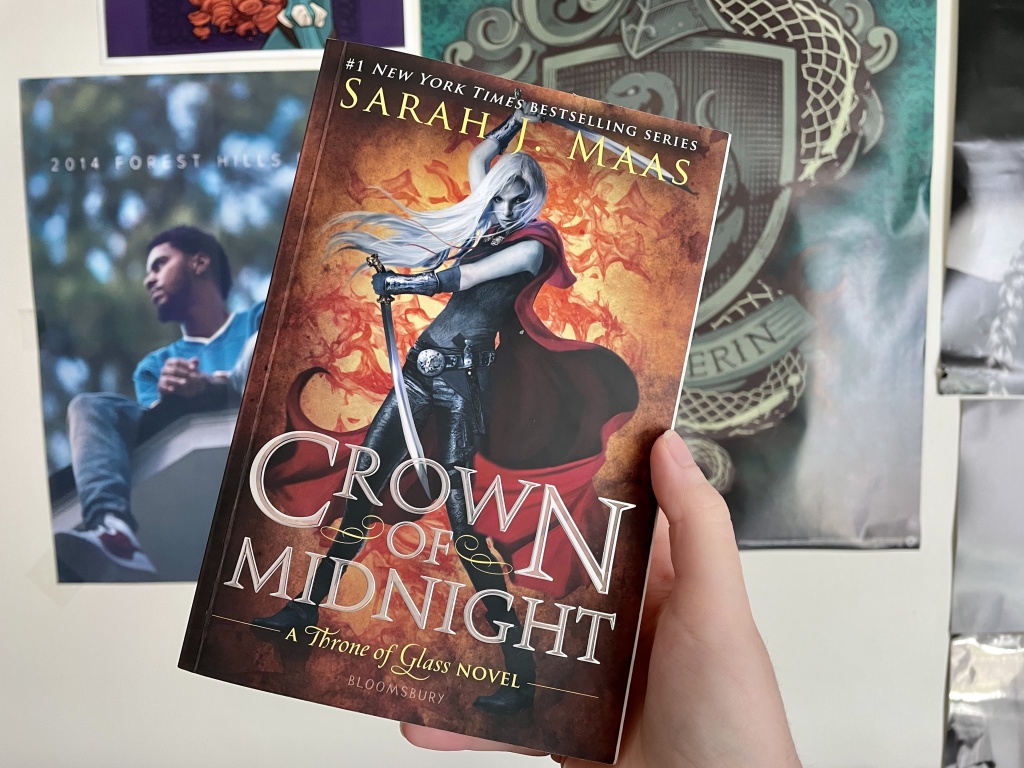
Crown of Midnight by Sarah J Maas  

Rating: ⭐️⭐️⭐️⭐️⭐️/5

Crown of Midnight is the second book in Sarah J. Maas’ Throne of Glass series. After winning the competition and becoming the King’s Champion in Throne of Glass, Celaena had to follow the King’s orders and kill his enemies. Maas delivered another hit with no misses in sight! In the second book, Celaena was very busy: tricking the King to make him think she was killing people, trying to find out the King’s evil plans for Erilea, searching for answers regarding the rebel group in Rifthold, and…falling in love with Chaol.

Crown of Midnight teemed with intrigue, mysteries, romance, tension, jealousy, deceit, heartbreak, death, and…revelations. With the pressure of the ancient Queen Elena and Ellywe’s Princess Nehemia, Celaena had to decide whether or not she would finally rise up against the King of Adarlan and take action to protect Erilea. Throughout the entire book, Celaena struggled with this. She had already lost so much. She feared losing the last remaining people she cared for if she did publicly rebel against the King. However, after a horrific event, Celaena made her choice.

I thoroughly enjoyed Crown of Midnight. I loved that Dorian and Celaena found common ground and friendship once more. They weren’t meant to be together, but they were meant to be the best of friends. That much was clear. I also enjoyed the romantic moments between Chaol and Celaena. She needed a little happiness, and he gave that to her…for a short time. I know Chaol was the Captain of the Guard, but his loyalty to the King annoyed me. At least the King’s evil plans were revealed to Chaol. Now he can stop being irritating with all that (slightly) blind loyalty.

I loved the twist and turns that came with each mystery and revelation during Celaena’s search for answers. At each step of her investigation, Celaena discovers something new, and sometimes those discoveries hurt her. It wouldn’t be a Maas book without some emotional trauma. I was crushed after a particular character’s death. And it was even more distressing seeing Celaena grieve. However, Celaena’s switch to revenge monster mode was excellent. I loved seeing the fierce assassin come out to play.

The revelation of Dorian’s powers and Celaena’s real identity were incredible! I relished every little clue to Celaena’s heritage, and the reveal of her true form sent excited chills through my body. I look forward to learning more about her past and experiencing the legend that is…Aelin Ashryver Galathynius.

 I enjoyed Crown of Midnight and can’t wait to see the story and action reach a whole new level in the next book.

Book Reviews

Daughter of the Moon Goddess Review

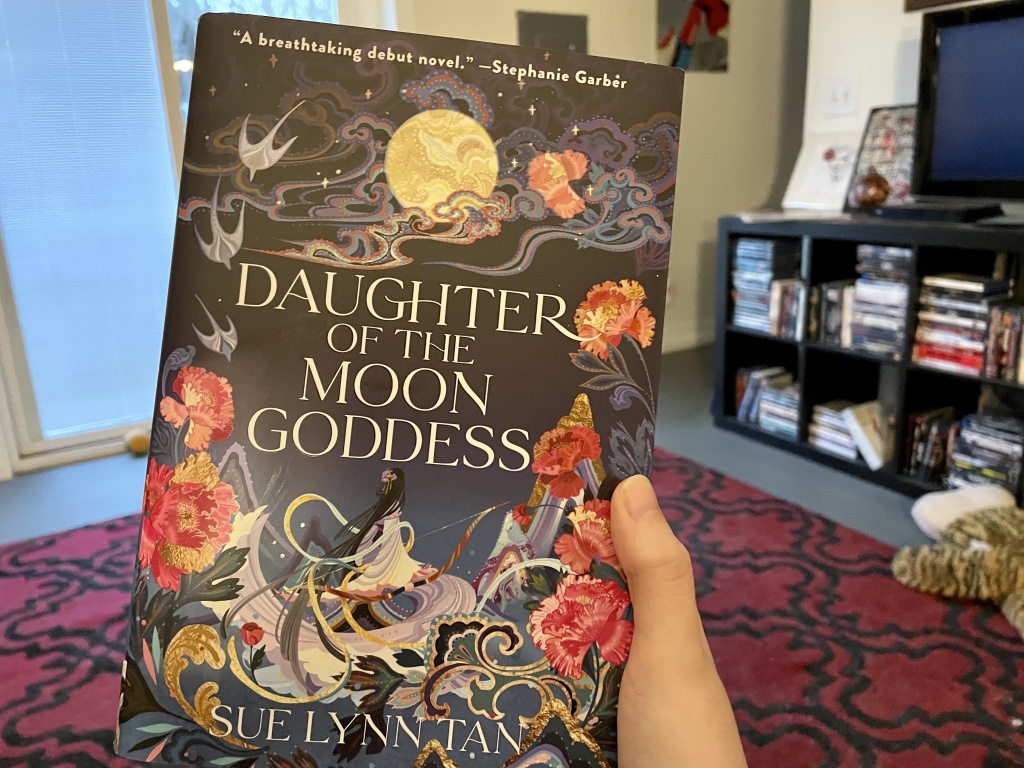
Daughter of the Moon Goddess by Sue Lynn Tan

Rating: ⭐️⭐️⭐️⭐️⭐️/5

Sue Lynn Tan’s debut novel Daughter of the Moon Goddess is a sensational story of a daughter leaving her home for the first time and trying to earn her mother’s freedom from the very Emperor that punished her. It is a retelling of the Chinese myth about the moon goddess Chang’e, filled with romance, angst, magic, action, betrayal, and honor. The cover is just as stunning and magical as the story. I know they say do not judge a book by its cover, but in this case…do it.

Xingyin is the daughter of Chang’e and the mortal warrior Houyi. She led a tranquil life on the moon with her mother for years. Still, Xingyin’s hunger for adventure would never make her truly happy living a sedentary life. After she is forced to leave her home, Xingyin’s story really begins. I loved how Xinygin could adapt to new environments and soak up every new skill and knowledge learned like a sponge. I enjoyed reading about Xingyin’s adventures after joining the Celestial Army. It was amazing to see Xingyin become a talented warrior that could take on mythical creatures and win the respect of her fellow soldiers. I loved how honorable Xingyin was. Even when she was tempted to go down a different path and give up her morals, she never did. She was tested emotionally, mentally, and physically and pulled through, showcasing Xingyin’s strength in her body and character.

The romance between Prince Liwei and Xingyin and later Captain Whenzi and Xingyin were pretty realistic compared to other fantasy novels I’ve read, which I liked. The foundations of friendship between Liwei and Xingyin were the key to their relationship. I wanted more romantic moments from Liwei and Xingyin, but unfortunately, a stupid betrothal to a princess got in the way. My chest tightened the moment Liwei’s betrothal was announced. Xingyin deserved better than that. But their story wasn’t over, which I had warring emotions about. Part of me wanted Xingyin to completely cut him off, and the other part wanted them to fight for their love. And then Whenzi entered the scene. I loved him much more than Liwei…at first. A love triangle always spices up a story, and this one was no different. I felt that Whenzi could challenge Xingyin and fight for her like no other. Also, Whenzi wasn’t the son of the Emperor and Empress, who hated Xingyin’s parents, so that was another point for him. However, Liwei loved her just as much and, in the end, proved that. Sigh. I don’t think the love triangle is finished quite yet, even if certain events at the end of the book tried to make me believe otherwise.

The Chinese culture and mythology displayed in Daughter of the Moon Goddess had to be one of my favorite parts of the book. It’s always exciting learning about another culture. Tan took every opportunity to embed Chinese customs, clothing, music, art, and more into the novel. I loved every word!

Oh. Did I forget to mention there were dragons? There were DRAGONS! That was enough to make me fall in love with the novel.

What I hated: the Celestial Emperor, the Celestial Empress, and Minister Wu. They were the absolute worst. I wanted to jump into the story and punch them whenever they were mentioned.

I adored Daughter of the Moon Goddess and recommend it to anyone that loves reading fantasy. You will not want to miss this gorgeous book.

Book Reviews

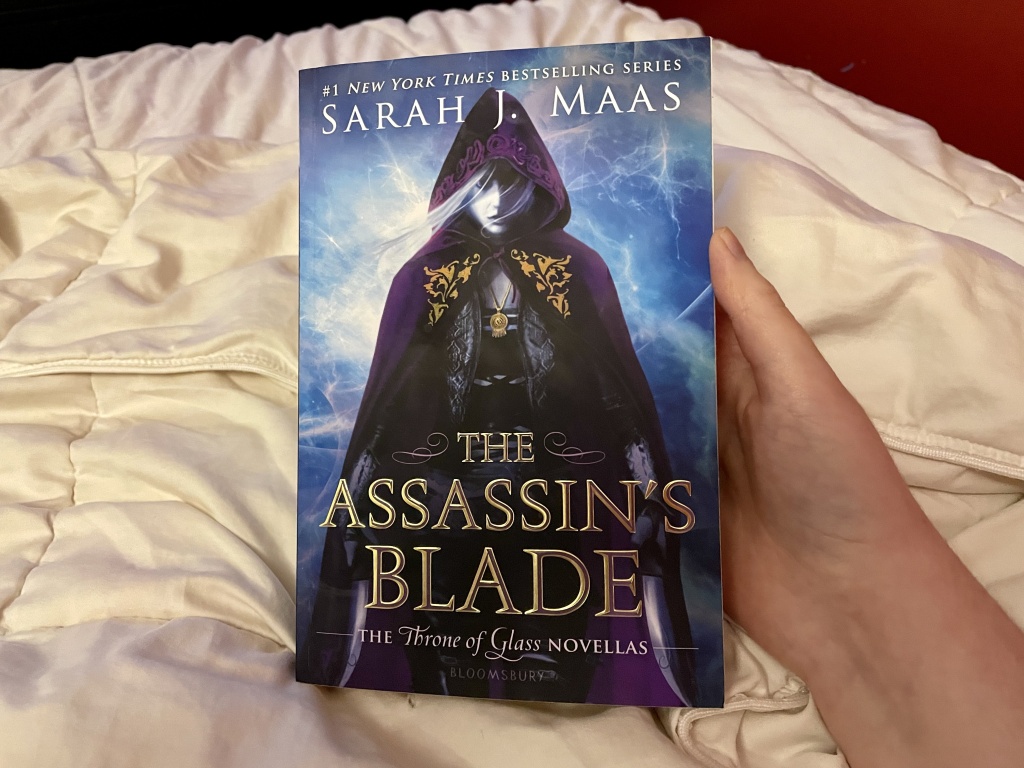
The Assassin’s Blade Review

The Assassin’s Blade by Sarah J Maas  

Rating: ⭐️⭐️⭐️⭐️/5

A group of novellas by Sarah J. Maas tell the story of Celaena Sordothein before the events of Throne of Glass. Each short story in The Assassin’s Blade encompasses the events that led to Celaena distancing herself from the King of Assassins and her eventual sentence to Endovier.

I loved reading about Celaena’s life before she was taken prisoner and sent to the slave camp. The events described in the book present glimpses of who Celaena was behind her confident mask and the trauma she went through before even being captured. The new characters introduced in each story were also lovely because new storylines were created that I wanted to hear more about. Rolfe was undoubtedly an interesting character. I would love to see more interactions between him and Celaena. Ansel was another character that stood out to me since she was Celaena’s first real female friend and showed a new vulnerability in Celaena.

The Red Desert story may have been my favorite. Celaena always thought she was the best, but the Silent Assassins humbled her a little. It was a nice change. The training methods were intriguing, and the improvements Celaena made were noticeable later in the book. This brings me to my next point. Although they were separate stories, they all connected. The stories built on one another to lead to the betrayal that changed Celaena’s life forever.

Sam Cortland was an absolute treat. I am heartbroken that we won’t see him again in the series. I liked that the romance was enemies to lovers, at least from Celaena’s perspective. It wouldn’t have fit Celaena’s character to have her get along with her rival in the Assassin Guild from the beginning. The handful of romantic moments I got between Sam and Celaena was precious. I’m super upset that Maas didn’t give us more. The ending hurt me in every way. Why does Maas create these characters I love and then hurt them so bad that I feel their pain? I don’t appreciate it…but keep going, Sarah. I cried while reading the final story. My emotions were all over the place after it was revealed who betrayed Celaena.

I enjoyed The Assassin’s Blade because, as usual, Sarah J. Maas cast a spell on me and made me feel attached to her characters. I look forward to seeing how the effects from the events in this book come back later in the series.

Book Reviews

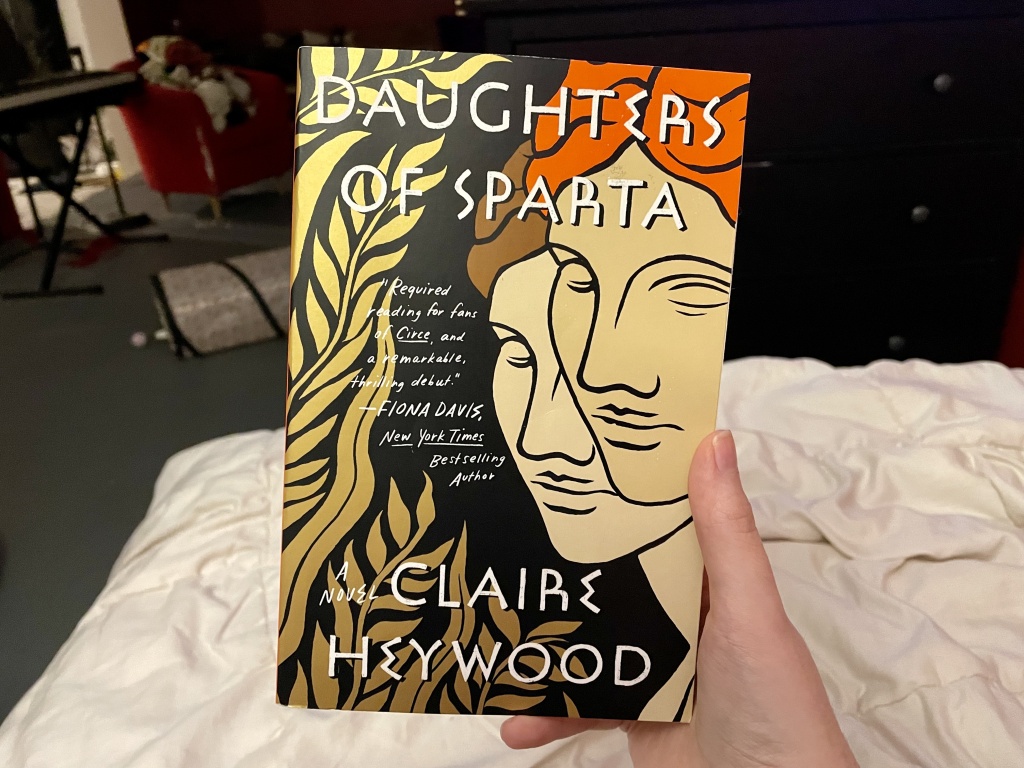
Daughters of Sparta Review

Daughters of Sparta by Claire Heywood  

Rating: ⭐️⭐️⭐️/5

Historical fiction about the Trojan War and Greek mythology is my weakness. So, I had to read Claire Heywood’s debut novel Daughters of Sparta, which follows the life of the princesses of Sparta, Klytemnestra and Helen. Two women raised to be subservient mothers and wives. Two women who were married to brothers and faced unhappy marriages that would lead to their break away from their obedient persona and making choices for themselves.

There is an obvious contrast between Klytemenstra and Helen from the beginning, but they are two sides of the same coin. Klytemenstra takes her role as a dutiful daughter and future queen very seriously. In her childhood and early years of her marriage, Klytemnestra followed every rule and strove to prove herself as a woman…or what society’s view on a woman was. After having kids, a new fierce and protective Klytemnestra awoke. She would do anything for her children and loved them with her whole being. As a Mycenae queen, Klytemnestra finally proved her worth as a leader once Agamemnon went off to war.

Now on the other side of the coin is Helen. Foolish, naïve Helen who just wanted love and affection from her mother and husband. In the early years of her life, Helen seemed slightly superficial. But as she grew older and married Menelaus, her desperation for a meaningful and loving connection to someone showed that she wasn’t a beautiful airhead. Helen wanted someone to love her unconditionally, even if she did not want to have more children after the horrific birth of her daughter. Unlike Helen’s sister, she never could embrace her role as a mother. I liked that Daughters of Spartashowed that not every woman was made to be a mother. Not every woman has that maternal instinct. And that is ok.

Although they have their differences, Klytemnestra and Helen both decided to turn away from the traditional views of women and tried to create their own path. Whether it would lead to tragedy or not…well that curse was hard to escape as a woman in Greek mythology. I felt nothing but anguish for Klytemnestra as her daughter was sacrificed for Agamemnon’s pride and greed. I sympathized with Helen, who realized her choice to leave Sparta led to nothing but death for those she knew and loved. Being a woman, it would have been difficult not to feel for these women. Heywood did a remarkable job of showing their struggles, strengths, and weaknesses. Neither Helen nor Kyltemnestra were written to be perfect angels who were victims. No. I got a true visual of who these women were. Nothing was hidden or sugar-coated.

More could have been said in Daughters of Sparta. I did not care for all the time jumps, and I would have liked more content. But what was written was incredible. I just needed more of it.

Overall, it was a good book and impressive for being Heywood’s first novel. Daughters of Sparta is perfect for all my readers that enjoy Greek mythology.

Book Reviews

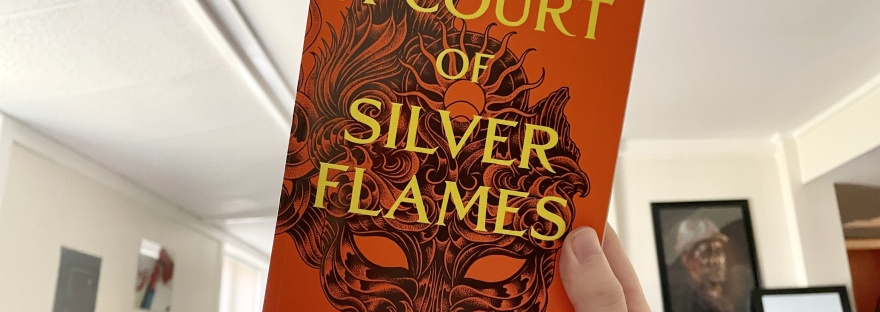
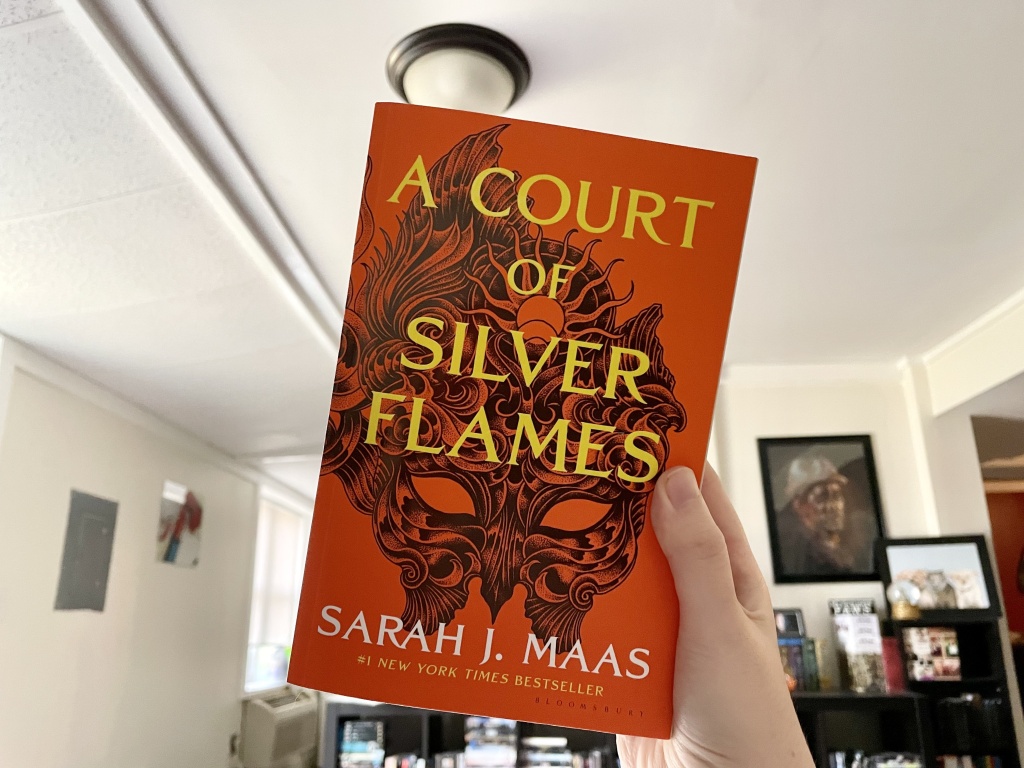
A Court of Silver Flames Review

A Court of Silver Flames by Sarah J Maas  

Rating: ⭐️⭐️⭐️⭐️⭐️/5

So, I finally read the latest book in the ACOTAR series. It took me a while to work up the interest to read it because A Court of Silver Flames focuses on Nesta, a character I never liked in the series. However, ACOSF has changed my mind entirely about the misunderstood female fae. ACOSF was gorgeous. Nesta’s trauma and healing journey left me emotionally exhausted by the end of the book. I cried at least three times while reading.

One of my favorite parts (and one of the most heartbreaking) of ACOSF is finally seeing why Nesta was so quick to attack and push others away. Her self-loathing gave me some clarity on Nesta’s actions but also made me sympathize with her. The inner workings of her mind opened a new place in my heart for Nesta, which made her inner turmoil even more saddening. It was inspiring to see Nesta become a warrior, acknowledge her mistakes, and move past them. I was so proud of Nesta by the end of ACOSF.

Another favorite of mine was the friendship and sisterhood Nesta finds in two new characters, Gwyn and Emerie. It was nice to see Nesta loosen up and find true friendship. I loved that they gossiped and connected over smutty books. Their conversations and jokes with one another never failed to make me smile. Nesta, Gwyn, and Emerie’s training to become Valkyries was amazing! I was full of pride seeing them anointed as full-fledged Valkyries. I can’t wait to see more of Gwyn, the fierce and musical sweetheart, and Emerie, the strong and teasing Illyrian, in future books.

Of course, I can’t review ACOSF without discussing Cassian and Nesta’s spicy relationship. Seeing a 500+ year-old Illyrian warrior nervous around a baby fae was hilarious. The banter between Nesta and Cassian always left a smile on my face. It was beyond entertaining to see two dominant characters meet their match. If you don’t like smut, this may not be the book for you because the sexual tension…and later activities will overwhelm you. The chemistry between Nesta and Cassian lit the pages on fire. But it wasn’t sex that made their relationship so intimate. The emotions Nesta finally revealed to Cassian made me love them as a couple. The moment they both let down their walls and opened up to each other was stunning. I love Nessian!

I had to mention a new favorite character from ACOSF… the House of Wind. Yes, a house. The House has a personality of its own, and I loved seeing how caring it was towards Nesta. My girl Nesta needed a friend to support her, and the House was the first. Sarah J. Maas is a genius. How she made me love a house…I will never understand.

I loved A Court of Silver Flames, and, as always, I recommend everyone read the ACOTAR series so you can experience the wonders, magic, and emotional rollercoaster that Sarah J. Maas has created.

Book Reviews

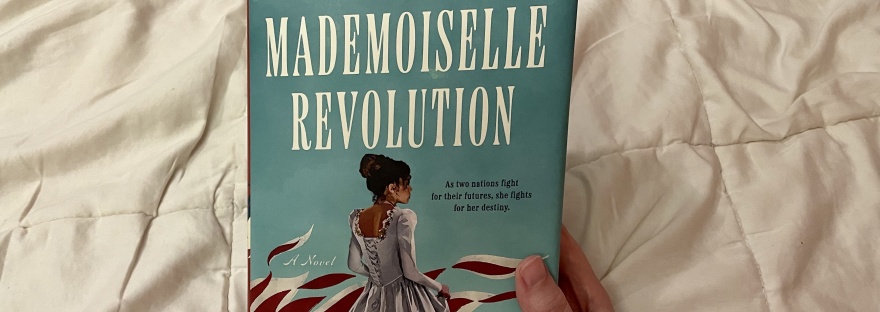
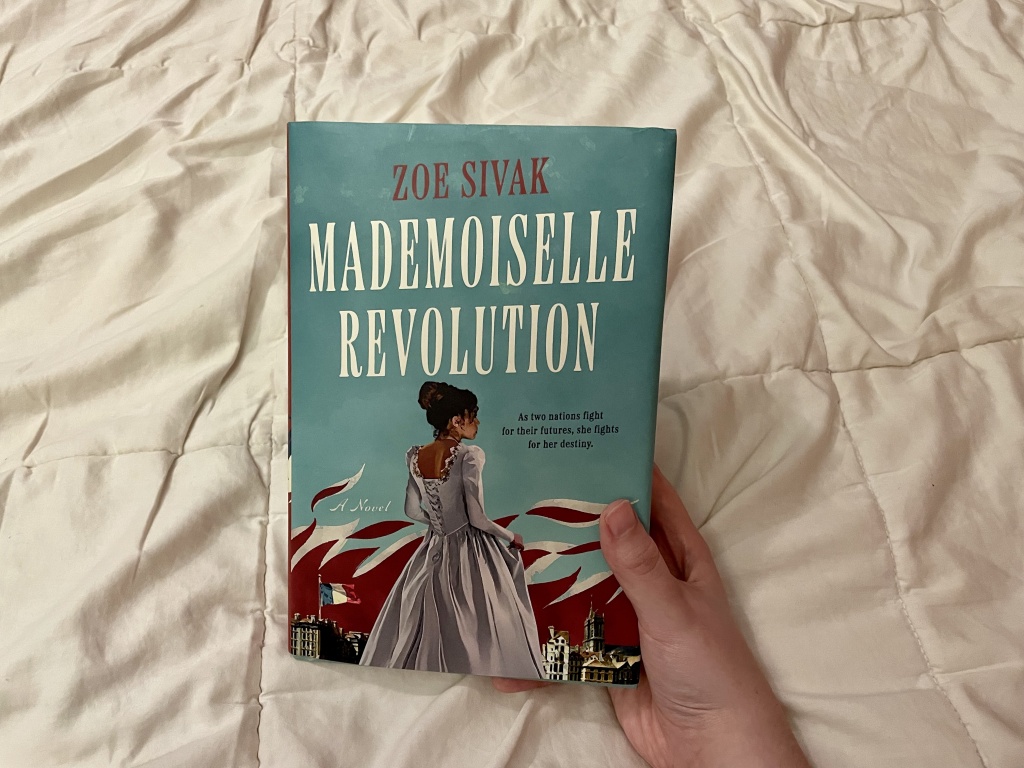
Mademoiselle Revolution Review

Mademoiselle Revolution by Zoe Sivak

Rating: ⭐️⭐️⭐️⭐️⭐️/5

I stumbled upon Mademoiselle Revolution during a spontaneous trip to the bookstore, and it was a blessing. Zoe Sivak wrote an enthralling and unforgettable book about a young biracial woman experiencing two bloody revolutions, the Haitian Revolution and the French Revolution, and trying to survive the carnage.

Sylvie de Rosiers is the daughter of a coffee plantation owner in Saint Domingue and an enslaved person who died during childbirth. All her life, she was ignorant of the horrific reality of slavery in Haiti. Yes, Sylvie experienced prejudice from society and even family members. Still, she never saw the true atrocity of slavery until it was forced right in her face. Mademoiselle Revolution starts just as the Haitian Revolution is coming to fruition.

In the beginning, Sylvie is a young ignorant girl who focuses more on her beauty than on discussing the political tensions rising in Haiti and France. Even though she seemed vain and self-centered at first glance, she had a saddening vulnerability and innocence that was moving. It was disheartening to read how Sylvie tried everything to keep her skin tone as light as possible. She knew she was beautiful, but that insecurity in the color of her skin as a biracial woman in a colony powered by slavery kept her chained to fear and self-doubt. Sylvie’s relationship with her father and eldest brother only tightened those chains as she realized the true crimes against the people her family made a fortune on. Thankfully, she at least had her other brother Gaspard. I loved him. Their relationship was endearing and pure compared to the obvious hatred her eldest brother had for her. After realizing her father could never accept all of her, Sylvie’s realization and complete breakdown were emotional to the core. The night Gaspard and Sylvie escaped during the slave rebellion came a little too soon for me. I would have loved to explore her life more in Saint Domingue and the slave uprising before Sivak took me to the Parisian city.

Sylvie and Gaspard may have escaped one revolution but entered a new one that would shape their lives…and possibly end it. The complete transformation of Sylvie from an ignorant child to an informed, passionate, and resilient woman was striking. Her connections to Cornélie Duplay and Maximilien Robespierre drove Mademoiselle Revolution once Sylvie came to Paris. Her infatuation with the attractive power of Robespierre’s presence and the safety he could provide Sylvie led her to Cornélie. Sylvie may have lusted for Robespierre, but the real romance blossomed between these two women, who both admired Robespierre, is what tugged at my heartstrings. Here are two women that were swept up in the charisma of a powerful man who would become a bloodthirsty tyrant in the name of “saving France.”

I loved how the romance in Mademoiselle Revolution was not black and white. It was not simple. It did not happen suddenly. The passion and love shared between Sylvie and Cornélie was warm yet…complicated. How could it not be when Sylvie strove to be at Robespierre’s side while falling in love with his mistress? I wanted their love protected at all costs, even more so when they fought, which could quickly get ugly. But they always found each other again. Their romance was behind closed doors and hidden in the shadows, but it was the most genuine relationship in the book.

I really wish Sylvie could have told Gaspard about her secret romance. I think he would have supported her no matter what. And that leads me to the sibling bond that never shattered even under extreme peril in France. Sylvie and Gaspard were there for each other. They were the other’s savior so many times, and their bond warmed my heart. After coming to Paris hoping for a new start, it hurt me to see the siblings be torn and beaten by the terror of the revolution. Yet somehow, her experiences did not break Sylvie.

One of my favorite moments from Mademoiselle Revolution was when Sylvie spoke to France’s National Convention to support the abolition of slavery in the French colonies. That moment solidified how much Sylvie changed and grew as a character from her days in Saint Domingue. I was so proud of who she became.

I adore Mademoiselle Revolution and highly recommend it to anyone who loves historical fiction. It is a jewel that needs to be shared.